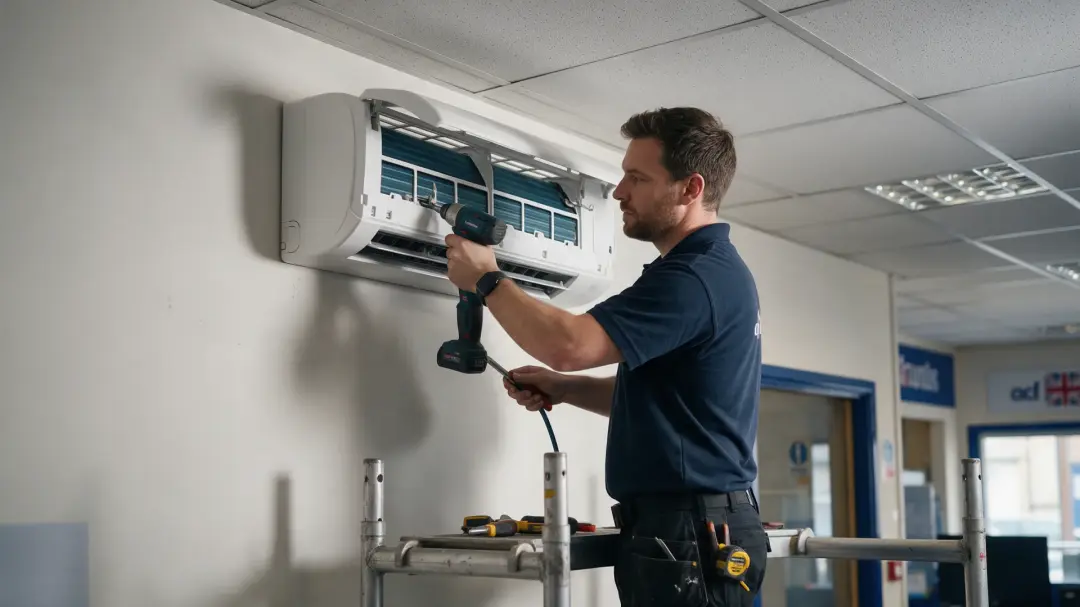
A bedroom air conditioner should direct air into the room without blowing across the bed. The best position also gives the installer a sensible route for pipework and drainage and leaves enough space to clean the filter. Before choosing a unit, show the installer where you sleep, how the room heats up and what you can hear at night.
Start with when the bedroom gets hot
In the 2024–25 English Housing Survey, 7% of households reported a bedroom that got uncomfortably hot, the highest result for any room type. This was a survey of how people experienced their homes. It doesn’t establish which system a particular room needs. For a bedroom in Plymouth, note whether the heat builds through the afternoon, peaks around bedtime or lingers into the morning. Give the installer the room dimensions, ceiling height, window direction and any insulation details you know. A loft bedroom under a sunny roof can behave quite differently from a shaded room of similar size. English Housing Survey overheating findings
Check where the air will actually go
Stand where the installer proposes to put the unit and look toward the bed. Think about where air will travel with the louvres in a normal cooling position, including where someone’s head will be on the pillow. Shelves, a tall wardrobe or heavy curtains can disrupt the flow or obstruct service access. If there are two candidate walls, ask the installer to explain how air returns to the unit and how each site would affect the pipe route. Leave measurements for the exact model to the installer because different units need different clearances.
Compare noise in the mode you’ll use

Ask for the manufacturer’s sound data at the fan speeds you are likely to use. A quiet-mode figure only describes that setting, which may move less air than the speed needed to cool a hot room before bed. Discuss whether you can cool the room earlier and use a gentler setting overnight. Look at the outdoor unit position at the same time. A bedroom window or a wall that can transmit vibration can make a location less suitable even if the indoor equipment itself is quiet. Ask how the unit will be supported and how maintenance access will work.
Work out where the water will drain
Indoor equipment usually creates condensate in cooling mode. If there is a suitable route for gravity drainage, the installer may be able to avoid a pump. Where a pump is necessary, ask where it will go, when it operates, how it sounds and how someone will reach it later. Give the installer the exterior layout as well as the bedroom plan. A short pipe route on paper can turn out to cross a path, neighbour’s boundary or part of the building where you need permission to make changes.
Check access before agreeing a position
Ask the installer to show where the indoor unit’s cover will open and how filters are removed. Check that you’ll be able to do normal user maintenance without moving a tall wardrobe or leaning over a bed. Agree where trunking and any wall penetrations will be visible. If you’re redecorating, show the installer your intended curtain rail, joinery and furniture layout. A position that works in an empty room can be awkward once everything is fitted. Leave space for future room use where the layout may change.
Test the result at handover
Ask to see how the controller adjusts temperature, fan speed and louvre position. Try a lower fan setting with the doors and windows as you normally use them. Get the installer to show where the drain finishes and what user checks are appropriate to that model. Keep the model details and instructions together so you can revisit the settings the next time the weather turns hot. If something about the airflow feels uncomfortable, explain where you notice it while the installer can demonstrate adjustments.
Plan cooling around where you sleep
Bring a room sketch, your preferred furniture layout and an idea of when the room gets hot. A site survey can establish a unit position, route and operating setup that work together.